Transporting oversized cargo between metropolitan hubs presents logistical hurdles that often leave individuals and small business owners weighing costly options. Standard parcel services routinely reject packages that exceed strict weight thresholds, while traditional moving companies tend to price their services based on full-vehicle capacity or dedicated day rates. When you need to relocate a single substantial piece of machinery, a collection of hefty boxes, or a dense piece of furniture across hundreds of miles, hiring an entire truck and crew frequently becomes prohibitively expensive. In these specific circumstances, commercial freight distribution models provide an exceptionally efficient alternative.
Pallet delivery networks operate across regional hubs every day, moving standardized wooden platforms laden with goods. While primarily designed for business-to-business commerce, private individuals and smaller enterprises can harness this infrastructure to transport unwieldy goods between major urban areas without paying premium prices.
Why pallet shipping works for single bulky items?
The fundamental appeal of pallet shipping lies in standard freight consolidation. When you hire an entire moving crew, you are essentially paying for their exclusive travel time, fuel, labor, and the empty cargo hold on the return journey. Conversely, freight carriers integrate individual pallets into broader national supply lines. Your cargo shares trailer space with dozens of other stabilized loads traveling in the same general direction, distributing transit overhead across multiple shipments.
Beyond cost consolidation, the physical structure of a wooden pallet establishes a robust barrier against transit damage. Heavy goods placed loosely inside a standard removal van remain vulnerable to shifting, abrupt stops, or improper weight distribution against softer cargo. A pallet anchors the item to a solid base, keeping the center of gravity low and consistent. Once an item is securely banded and shrink-wrapped, material handlers move the load exclusively using hydraulic pallet jacks and forklifts. This mechanical process entirely eliminates the drops, scuffs, and manual handling injuries often associated with crew members carrying awkward items through tight stairwells or doorways.
Cost differences between freight networks and moving vans
Comparing the financial models of dedicated removal vans versus freight networks highlights a vast pricing disparity. A removal van quote generally accounts for door-to-door transit time, two or more crew members, congestion charges, and fuel costs calculated specifically for a point-to-point journey. Transporting a heavy workshop tool or commercial appliance from London to Manchester via a dedicated van can quickly escalate into hundreds of pounds, primarily because the provider cannot easily monetize the unused space in their vehicle.
In stark contrast, pallet courier rates depend heavily on standard dimensions and weight categories rather than dedicated travel hours. Pallet networks divide consignments into micro, quarter, half, and full pallet spaces. If your heavy shipment fits neatly within the standard base dimensions of a standard platform and does not exceed the weight ceiling, you pay a flat tier fee for that space. Professional logistics providers like PMA Transport leverage these consolidated routes to provide dependable freight movement, proving that you do not need to book an entire dedicated vehicle when your goods only occupy a few square feet of floor space.
How to prepare and secure heavy freight on a pallet?
Maximizing the protection of your shipment requires methodical preparation, as pallet couriers enforce strict packaging standards before accepting cargo into their regional hubs. Securing heavy items starts with selecting a sturdy, undamaged wooden base capable of supporting the intended weight. Ensure that the cargo sits completely within the perimeter of the base, as any overhang risks impact damage from adjacent pallets inside the line-haul trailer.
Begin by placing protective padding, heavy-duty cardboard, or foam sheets around fragile surfaces and finished edges. For machinery, drain all fluids such as oils and fuels completely to comply with hazardous goods regulations and prevent slick residues from compromising the pallet deck. Once cushioned, utilize heavy-duty ratcheting straps, polyester banding, or steel tensioners to anchor the item directly through the bottom deck boards. This step ensures that the load cannot slide sideways during braking or turning maneuvers.
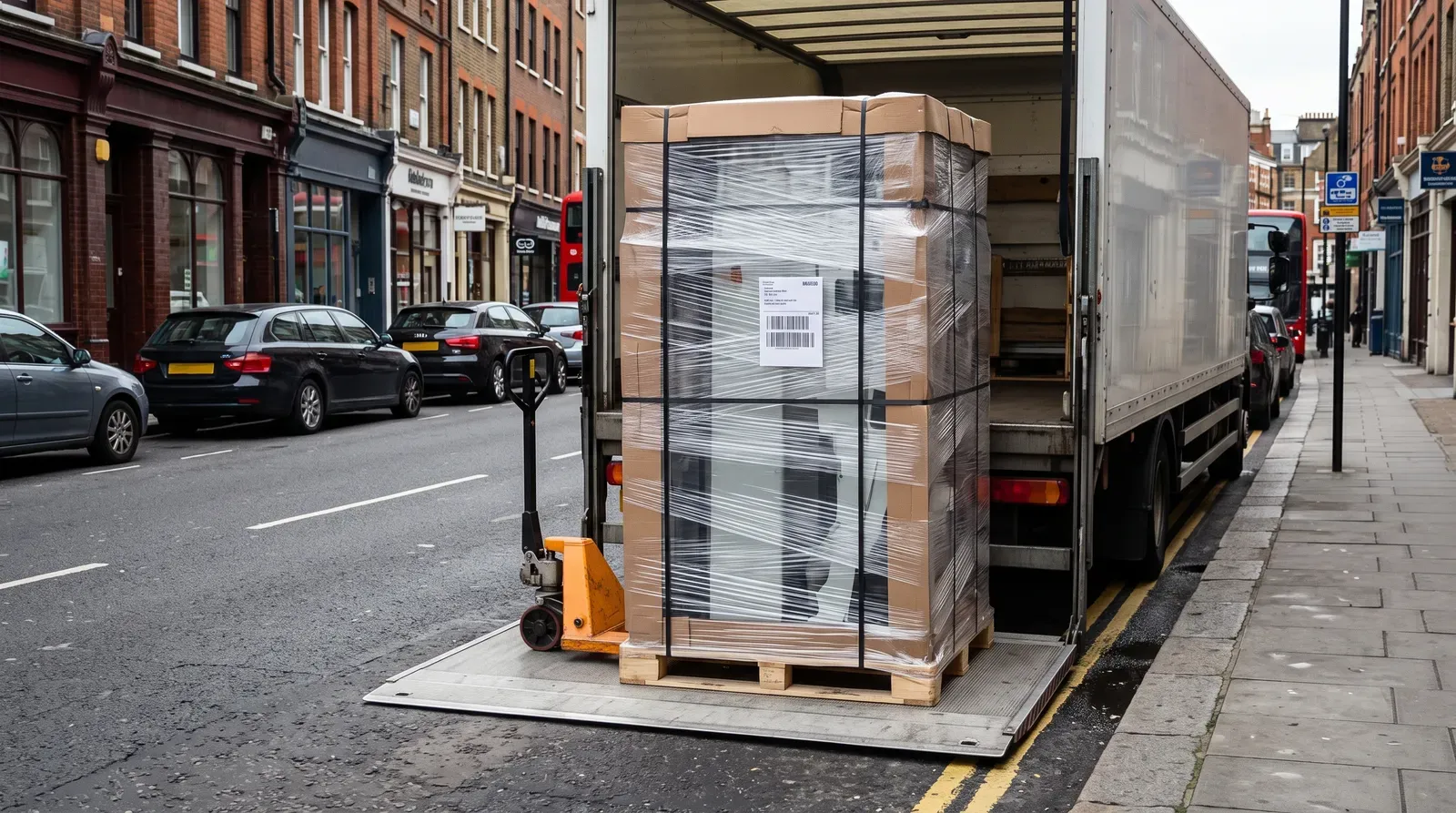
Finish the packing process by applying multiple layers of industrial-grade stretch wrap around the entire assembly. Start wrapping at the base, working upward to tightly bind the cargo to the pallet itself. The wrap keeps out road dirt, moisture, and road vibrations while stabilizing smaller modular parts. Finally, attach clear shipping labels with legible destination addresses and barcodes to at least two opposite sides of the shrink-wrapped unit, ensuring that handling crews can scan the details rapidly at interchange hubs.
City access limitations for large delivery trucks
While pallet networks offer distinct economic advantages, their operational mechanics demand careful consideration of local urban access. Freight distribution companies typically deploy large rigid trucks equipped with hydraulic tail lifts to perform street-level pickups and drop-offs. These eighteen-ton vehicles require significantly more maneuvering clearance than a common cargo van.
Narrow residential streets, tight historic town centers, low-hanging tree branches, and severe parking restrictions can prevent a tail-lift truck from pulling directly alongside your curb. Furthermore, hydraulic pallet trucks can only roll across smooth, solid surfaces like flat asphalt, tarmac, or level concrete. They cannot navigate gravel driveways, steep inclines, grass, or curbs. If your collection or drop-off address features pedestrianized zones, gated entries, or cobblestone alleyways, you must arrange an accessible curbside loading location nearby. Failure to account for these environmental factors can result in missed collections, re-delivery fees, or the driver refusing the load entirely.
Key situations where pallet couriers make the most sense
Opting for a pallet courier delivers clear advantages whenever your shipment meets certain criteria involving weight, form factor, and handling requirements. Industrial equipment, gym weights, automotive engines, flat-pack materials, and bulky pottery are notoriously difficult to pack into standard parcels and excessively costly to move via specialized moving crews. In these cases, the sheer density of the materials makes a pallet the ideal platform.
Similarly, commercial clear-outs, trade show logistics, and online marketplace purchases benefit tremendously from the palletized model. If you purchase heavy manufacturing tools or substantial architectural salvage from a seller located in another city, scheduling a pallet pickup provides a standardized, tracked solution that spares both parties the awkwardness of coordinating private vehicle transit. As long as you possess the means to safely pack the goods and ensure clear truck access at both locations, freight networks present an unbeatable balance of affordability, freight safety, and operational speed.
Choosing the right logistics approach for your journey
Determining the best way to move large possessions comes down to weighing the hands-on service of an independent mover against the mechanical efficiency of commercial freight networks. If you are moving delicate personal heirlooms that cannot be strapped down, or if you lack the physical capability to prepare and load a wooden base curbside, the higher price of a full-service van crew remains justified. Their labor covers navigating interior stairs, wrapping furniture in moving blankets, and handling door-to-door placement.
However, when your goods are dense, resilient, or readily secured to a base, adopting the pallet delivery route saves considerable money and simplifies the entire interstate shipping timeline. By understanding vehicle access rules and packing your freight securely, you turn complex regional transport into a straightforward logistics routine that keeps your valuable items safe from point of origin to final destination.